
Harper Richter · 5 November 2026
Exploring Microbial Networks That Trigger Synchronized Flowering Across Greenhouse Plant Collections
Greenhouse operators have observed coordinated blooming events across diverse plant species for decades, yet the underlying drivers remained unclear until recent investigations into soil microbial communities gained momentum. These networks involve bacteria, fungi, and other microorganisms that interact with plant roots through chemical signaling pathways, and researchers now trace synchronized flowering to specific microbial metabolites that influence plant hormone production. Data from controlled greenhouse trials show that certain rhizosphere bacteria release compounds which accelerate the expression of flowering genes in multiple plant varieties at once, creating uniform bloom cycles even when species differ in their natural timing.
Microbial Signaling Pathways in Root Zones
Quorum sensing among soil microbes allows populations to coordinate the release of signaling molecules once they reach critical densities, and this process extends to plant hosts through shared chemical cues. Studies indicate that mycorrhizal fungi form extensive hyphal networks linking root systems of neighboring plants, facilitating the transfer of nutrients and informational compounds that trigger developmental responses. In greenhouse settings where irrigation and temperature remain constant, these networks amplify the effect, so that a signal initiated in one pot can propagate across an entire collection within days. Evidence from European agricultural research centers points to specific strains of Pseudomonas and Bacillus species that produce florigen-like precursors, substances which plants then convert into proteins directing flower bud formation.
Greenhouse experiments conducted through 2025 and into 2026 revealed that disrupting these microbial connections with targeted antibiotics delayed flowering by up to three weeks in test groups, while untreated controls maintained tight synchronization. Observers note that the same microbial consortia appear across different greenhouse facilities, suggesting that commercial potting mixes and shared water systems help establish consistent communities capable of driving collective plant behavior.
Case Studies from Commercial and Research Facilities
One facility in the Netherlands documented synchronized flowering in a mixed collection of petunias, tomatoes, and chrysanthemums after introducing a commercial microbial inoculant containing arbuscular mycorrhizal fungi. Flowering occurred within a 48-hour window across all species, whereas previous seasons without the inoculant showed staggered bloom periods spanning ten days or more. Similar patterns emerged at a Canadian research station where researchers tracked microbial community shifts using DNA sequencing, finding increased abundance of certain Actinobacteria coinciding with peak bloom coordination in November 2026 trials.
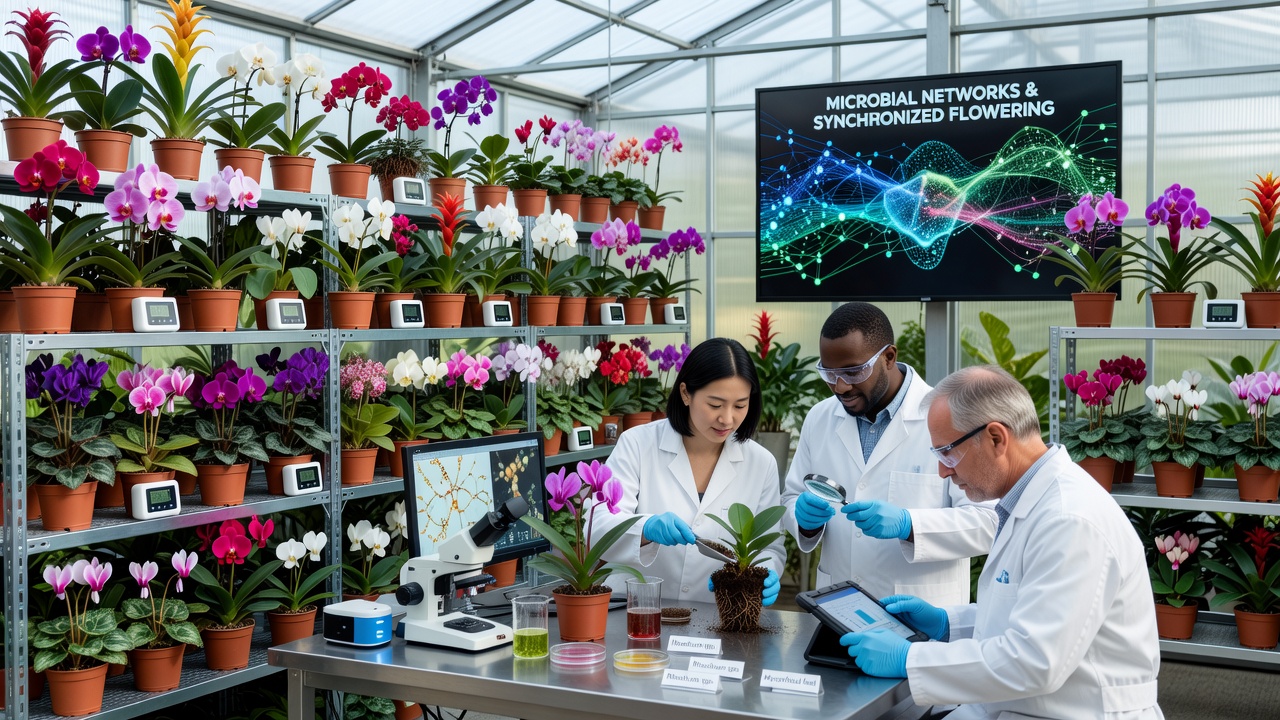
Researchers at Australian institutions have examined how volatile organic compounds produced by soil bacteria travel through air spaces in greenhouse environments, providing an additional layer of communication beyond root connections. These airborne signals appear capable of priming distant plants for flowering even without direct root contact, which explains why synchronization sometimes occurs in hydroponic setups lacking traditional soil matrices. Figures from ongoing projects show that blocking these volatiles with air filtration systems reduces the degree of coordination, confirming their role alongside underground networks.
Environmental Factors Modulating Microbial Influence
Temperature fluctuations, light cycles, and nutrient availability interact with microbial activity to either strengthen or weaken flowering synchronization. In conditions where greenhouse operators maintain stable parameters, microbial networks exert stronger control because plants rely more heavily on external chemical cues rather than internal seasonal triggers. Data collected across multiple sites indicate that elevated carbon dioxide levels common in enclosed greenhouses can stimulate certain fungal species to produce more signaling metabolites, further tightening bloom timing. Yet changes in watering frequency disrupt biofilm formation on root surfaces, which in turn interrupts the continuity of microbial networks and leads to less uniform flowering responses.
Those who manage large plant collections often adjust substrate composition to favor beneficial microbes known to promote synchronization, selecting mixes with higher organic matter content that support diverse bacterial populations. This approach has become standard practice in several commercial operations because it reduces the need for manual interventions such as hormone sprays to align flowering for market demands.
Conclusion
Research continues to map the precise molecular interactions within these microbial networks, with new sequencing technologies allowing finer resolution of which species contribute most to flowering signals. As greenhouse agriculture expands to meet year-round production needs, understanding these underground and airborne communication systems provides practical tools for managing plant development at scale. Findings released in late 2026 from collaborative projects across North America and Europe underscore the consistency of microbial-driven synchronization under controlled conditions, pointing toward future applications in precision horticulture that leverage natural biological networks rather than synthetic inputs alone.